Health Intelligence
The Enbodie Trust Index: How One Letter Is Built
Darren Crowder · · 9 min read

Every product Enbodie grades gets one letter, A to E. People ask what the letter is made of, who decides it, and whether a brand can buy a better one. This post answers all three. The short version: the letter is arithmetic, the arithmetic starts from toxicology and the law, and no person, brand or AI model can move it.
Last reviewed 4 November 2026.
1. A letter always comes with a status
The Trust Index is not only a grade. Beside every letter sits a status that says how much we actually know. A product is graded, or it is held for insufficient evidence, or it sits in a category we do not grade at all. We would rather show "not enough evidence" than a confident C built on guesses. A letter with no status would be a marketing device. A letter with its status is a measurement.
2. Every product is judged by the right yardstick
A moisturiser, a vitamin D tablet and a prescription inhaler are not safe or unsafe in the same way, so we do not score them the same way. The first thing the index does is decide what kind of product it is looking at and send it to the matching engine.
- Cosmetics, toiletries, baby products and fragrances are judged on a margin of safety, the method the Scientific Committee on Consumer Safety (SCCS) uses in Europe.
- Supplements and foods are judged against upper intake limits set by bodies such as the European Food Safety Authority (EFSA) and the UK Scientific Advisory Committee on Nutrition.
- Medicines, medical devices, tattoo inks, clothing and household goods are not graded. A medicine's benefit is a clinical decision, not a consumer-safety sum, so a drug on Enbodie never shows a cosmetic grade. We say plainly that no engine applies.
A sunscreen is the one deliberate exception. It is often regulated as a medicine, but its UV filters are cosmetic chemistry, so it goes back to the cosmetic engine where the right data lives.
3. The hazard sum: NOAEL ÷ SED
For a cosmetic, every ingredient is put through the same sum you will see at the bottom of our home page. The No Observed Adverse Effect Level (NOAEL) is the daily dose at which toxicology studies found no harm. The Systemic Exposure Dose (SED) is what your body actually receives from this product at this concentration, used this often, absorbed through skin, spread over your body weight. Divide one by the other and you have the Margin of Safety.
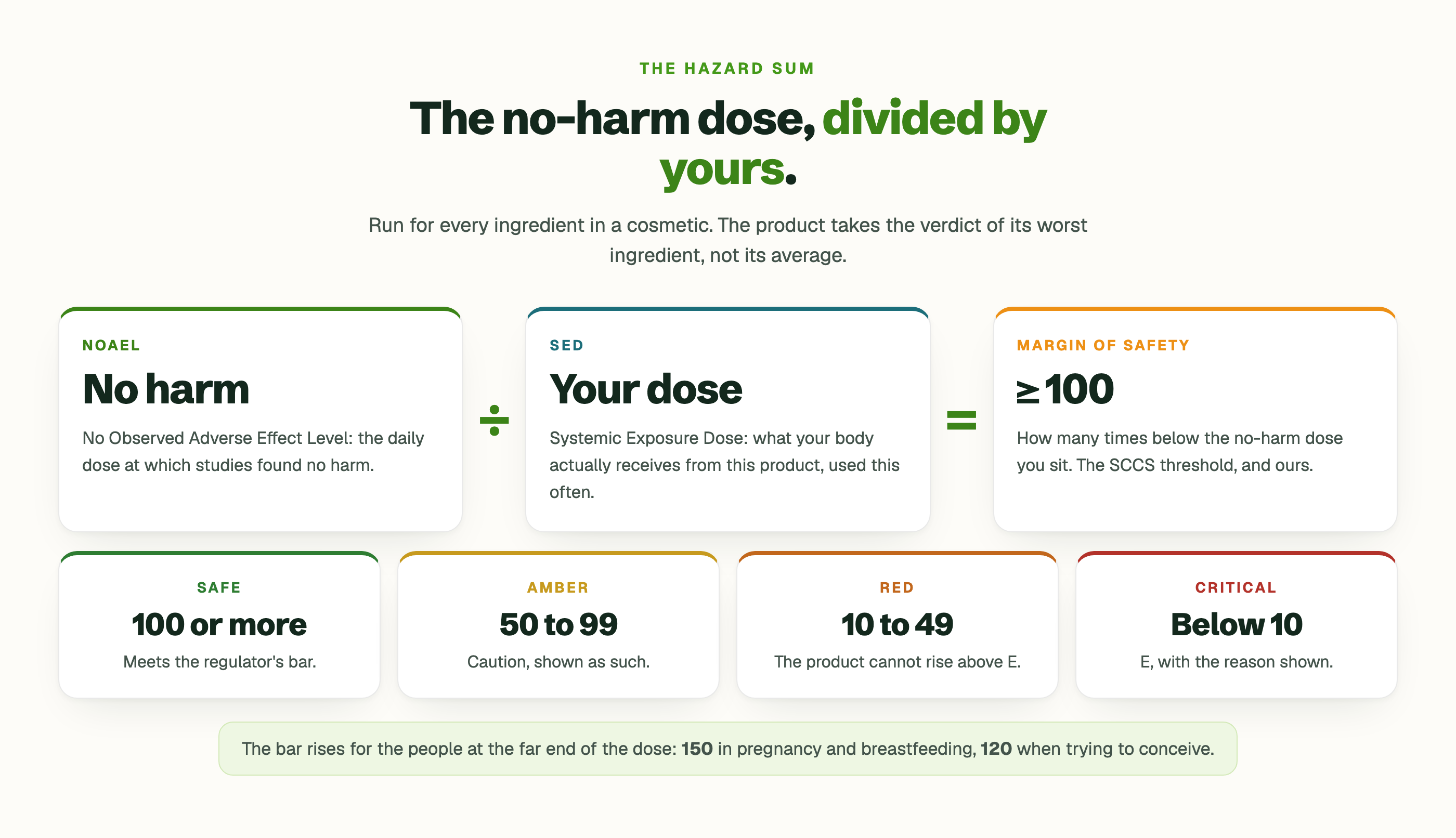
SCCS treats a margin of 100 or more as safe, and so do we. Between 50 and 99 we show amber. Between 10 and 49 we show red. Below 10 is critical. For pregnancy and breastfeeding the bar rises to 150, and for anyone trying to conceive it rises to 120, because the people at the far end of the dose are not average adults.
The product's verdict is set by its worst ingredient, not its average. A formula with nine good ingredients and one bad one is a product with a bad ingredient in it.
Your body does not experience ingredients in isolation. It experiences accumulation, so the grade follows the worst drop in the barrel, not the average.
4. Where the numbers come from, and how honestly they are labelled
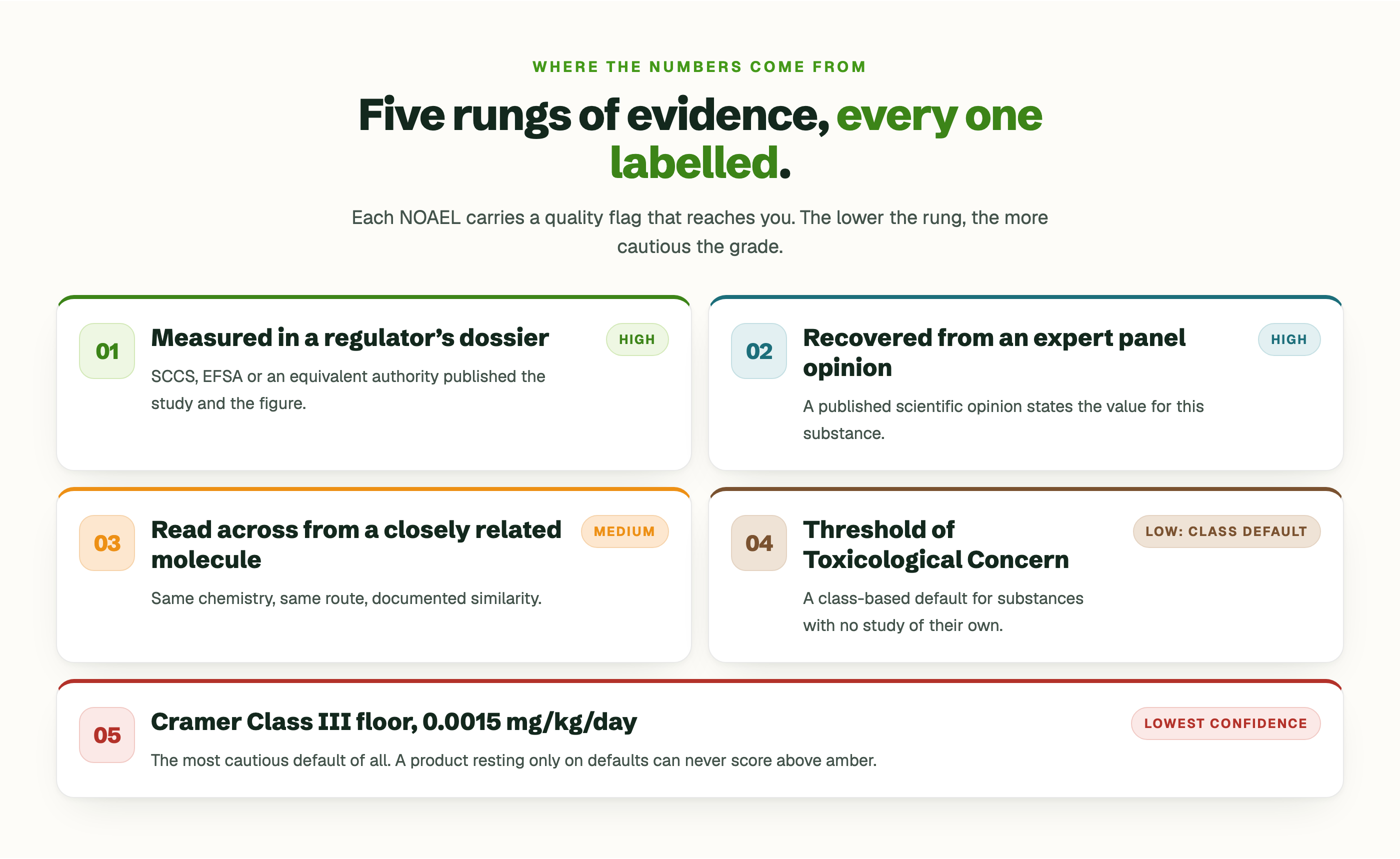
Every NOAEL carries a quality flag that reaches the user. Measured in a regulator's own dossier is the top of the ladder. Below that sits a value recovered from an expert panel opinion, then a value read across from a closely related molecule, then a class-based default called the Threshold of Toxicological Concern. At the very bottom is the most cautious default of all, the Cramer Class III floor of 0.0015 milligrams per kilogram per day, which we use when nothing better exists. If every ingredient in a product is sitting on a default, the product can never score better than amber, however clean it looks.
Amounts are labelled the same way. A concentration cap published by a regulator beats a range the brand declared, which beats an estimate from where the ingredient sits in the INCI list. Most products on sale do not declare percentages, so most of our exposure figures are honest estimates, and we say so rather than dress them up.
5. Six pillars, one grade, and the real arithmetic
The hazard sum is the heart of the index, but it is not the whole of it. The home page shows six pillars in the language of your body: skin, hormonal safety, allergens, cumulative exposure, sourcing and sustainability. Underneath, the engine scores six questions and weighs them out of 100: hazard (the margin-of-safety result above), exposure (how much reaches you, and how often), regulatory (allowed, restricted or banned where you are standing), population fit (does it suit the life stage and sensitivities you told EVI about), evidence (how much rests on measured data rather than defaults) and sustainability (sourcing, environmental impact, integrity of claims and transparency).
Here is the part most people assume and we do not do: there is no single set of weights. A shampoo, a multivitamin and a baby lotion are not the same kind of risk, so each product type carries its own weights, held in a table the engine reads at grading time. These are the shapes running today.
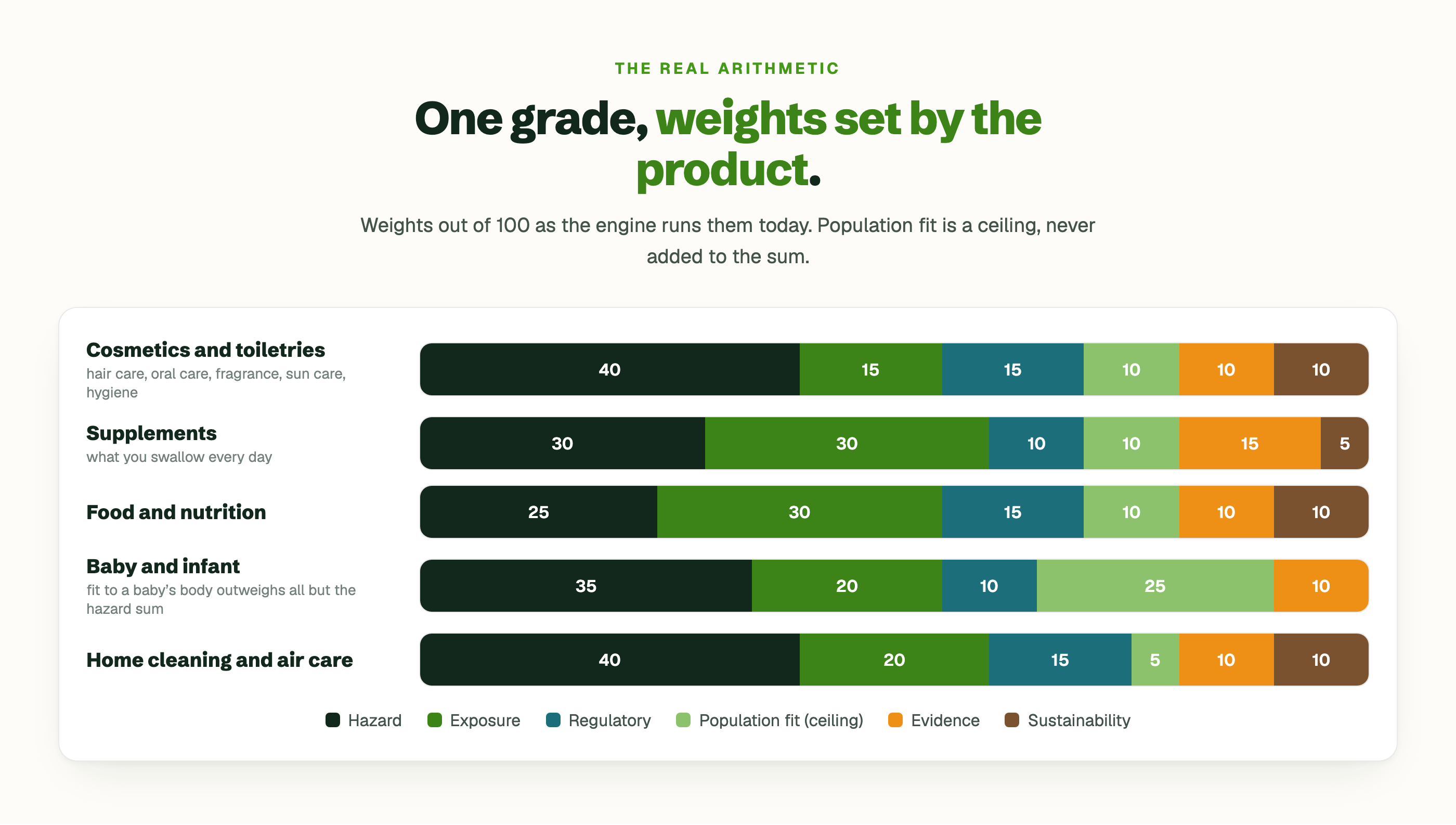
- Cosmetics, hair care, oral care, fragrance, sun care and personal hygiene: hazard 40, exposure 15, regulatory 15, population fit 10, evidence 10, sustainability 10.
- Supplements: hazard 30, exposure 30, regulatory 10, population fit 10, evidence 15, sustainability 5. What you swallow every day matters as much as what it is.
- Food and nutrition: hazard 25, exposure 30, regulatory 15, population fit 10, evidence 10, sustainability 10.
- Baby and infant products: hazard 35, exposure 20, regulatory 10, population fit 25, evidence 10, sustainability 0. The fit to a baby's body outweighs everything except the hazard sum.
- Home cleaning and air care: hazard 40, exposure 20, regulatory 15, population fit 5, evidence 10, sustainability 10.
Where a country has published its own view of a product type, the engine takes that country's weights first, then the Enbodie standard for the product type, and only then a general cosmetic shape as a last resort. Every stored grade records which of those it used.
Three rules sit on top of the weights, and they matter more than the numbers.
- Population fit never adds points. It is a ceiling, not a pillar in the sum. A product that is a poor fit for you is held down; a product that is a good fit is not lifted up for it.
- Regulatory only counts when it is clean. If an ingredient fails the law where you live, the grade is an E before any weighing happens (section 6). So the regulatory pillar can confirm a grade, never rescue one.
- A pillar we cannot measure is left out, not scored as a neutral 50. If exposure or sustainability is still provisional for a product, its weight is removed and the remaining pillars are rescaled to 100. The grade rests only on what was actually measured, and the evidence pillar and status label tell you how much that was.
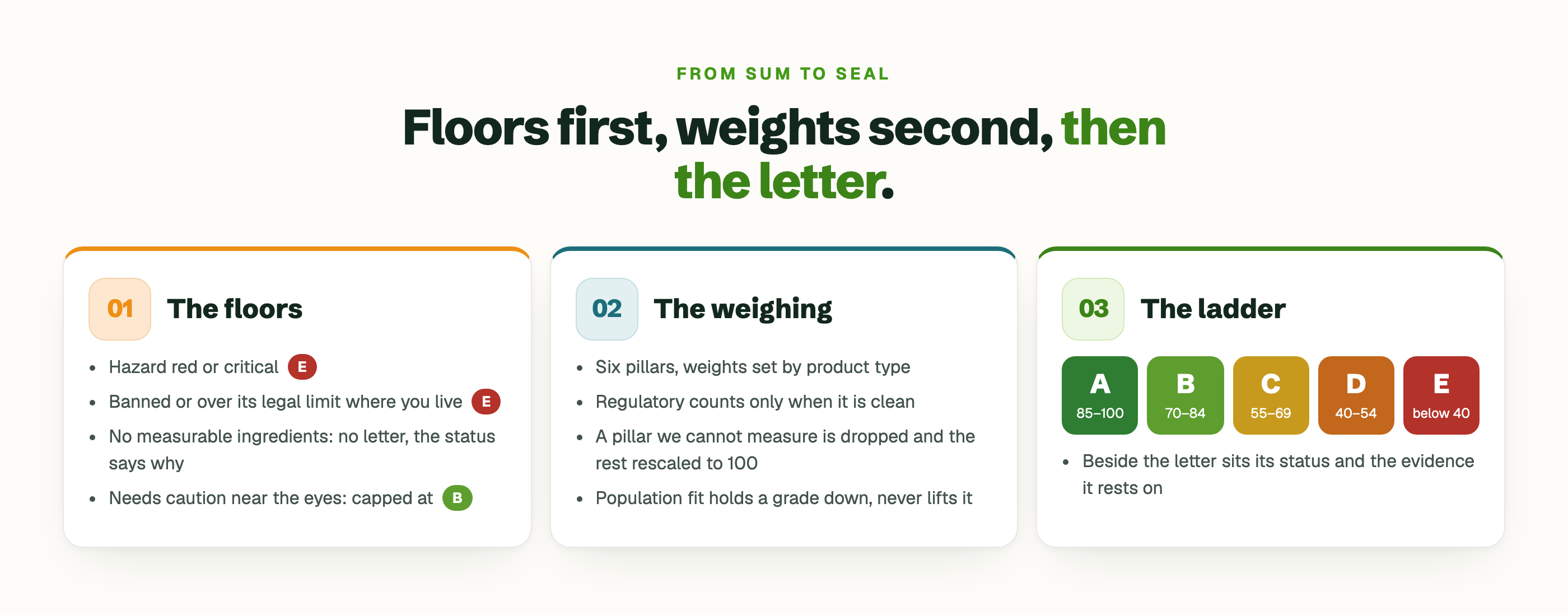
The total maps to the ladder you see on the seal: 85 to 100 is an A, 70 to 84 a B, 55 to 69 a C, 40 to 54 a D, and below 40 an E.
6. The floors nobody can argue with
Weights can be gamed. Floors cannot. If the hazard sum lands red or critical, the product is an E whatever its other pillars say. If an ingredient is banned or over its legal limit where you live, the product is an E, and the reason shown is the restriction, not a score. A product that cannot answer the hazard question at all gets no letter. And some ceilings pull the other way: a product that needs caution around the eyes cannot rise above a B, however good the rest of it is.
7. Law first, our score second
The regulator in your market has already made rules, and those rules sit above anything Enbodie calculates. We check every ingredient against the law of the place you are standing in, and we show that legal position before our own score. Our score can add caution on top of the law. It can never rescue a product the law has already failed.
Law first, our score second. Our score can add caution on top of the law; it can never rescue a product the law has already failed.
A ban is applied where its law applies. Where another regulator has banned an ingredient that yours has not, we tell you, name that regulator, and let you decide. We do not quietly borrow one country's law to grade another.
8. AI explains the grade. It never decides it
EVI, our agent, will talk you through why a product scored as it did and what a better swap might be. EVI does not touch the number. The grade is computed by fixed arithmetic against ELI, our evidence layer, and it is the same whoever asks and whenever they ask. The only thing that changes it is new evidence: a new regulator opinion, a corrected concentration, a measured NOAEL replacing a default.
9. What we still cannot do
We hold measured NOAEL values for tens of thousands of substances, and the rest sit on the defaults in section 4. Most concentrations are inferred, not declared. A large share of the products in our catalogue carry no letter yet because the evidence is not there to defend one, and we would rather show that gap than paper over it. Every one of those gaps is on a register with an owner and a date.
What this does not mean
A Trust Index grade does not diagnose anything, and it is not a substitute for advice from a qualified health professional. An E means the evidence for the ingredients, in the amounts we believe are present, does not meet the standard a regulator would apply. It does not mean the product has harmed anyone.
If you think a grade is wrong, write to info@enbodie.me with the product and the primary source you believe we have missed. If the source holds up, the grade changes, and it changes for everyone.